

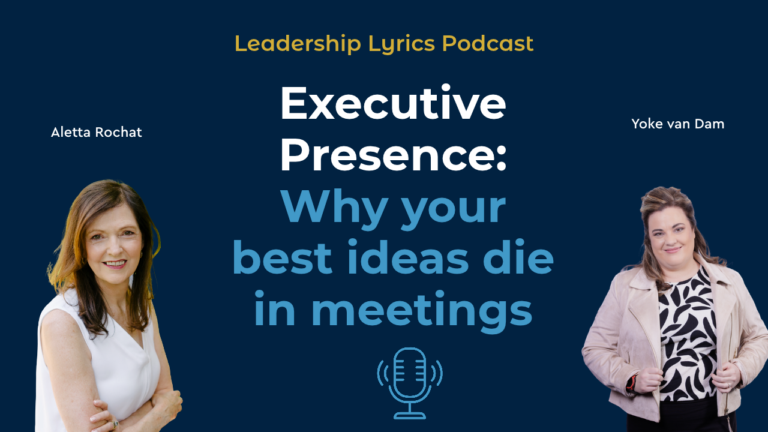

Leadership lessons from my conversation with Aletta Rochat
What does it really mean to have executive presence?
Is it how you dress?
How confidently you speak?
How much space you take up in a room?
Or is it something much deeper?
In my conversation with Aletta Rochat on the Leadership Lyrics podcast, we explored what executive presence really looks like when leadership is tested by different cultures, strong opinions, difficult conversations and the pressure to make decisions.
Aletta brings a fascinating perspective. She was the first person from Africa to serve as International President of Toastmasters International, and her experience as a global speaker, author and executive coach has given her a front-row seat to leadership across cultures and contexts.
One of the things I loved about our conversation was that she brought executive presence back to something very human:
How do people experience you when you walk into the room?
Connection before position
Leadership is not simply about the position you hold.
You can have the title, the authority and the seniority, but if people don’t feel seen, heard or respected by you, your influence will be limited.
Aletta spoke about her experiences travelling and working with people from very different cultures. Whether she was in India or interacting with leaders from other parts of the world, one lesson kept coming through:
Connection matters.
The ability to be curious about another person’s world. To listen. To notice. To understand that your way of communicating is not necessarily someone else’s way of receiving information.
That is where leadership gets interesting.
Executive presence is about how people experience you
We often think executive presence means looking polished, speaking confidently and appearing like you belong at the table.
But Aletta challenged that idea.
Executive presence is not about being the biggest personality in the room.
It is about how you show up and, importantly, how other people experience you.
Can you influence without dominating?
Can you persuade without forcing?
Can you create space for other people to contribute?
Can you listen to a viewpoint that challenges your own without immediately becoming defensive?
That, to me, is where executive presence becomes much more than presentation skills.
It becomes a leadership skill.
And authenticity matters.
People are remarkably good at sensing when someone is performing leadership rather than actually leading.
The room is bigger than you think
One of the biggest challenges for leaders working across cultures is assuming that everyone interprets behaviour in the same way.
They don’t.
What looks confident in one culture might be perceived as aggressive in another.
What looks respectful in one environment might be interpreted as disengagement somewhere else.
Even our understanding of authority can be very different.
Aletta shared how important it is to become an observer.
Watch the room.
Notice the micro-expressions.
Pay attention to body language.
Listen not only to what is being said, but to what might not be being said.
This is where emotional intelligence becomes incredibly practical.
You are not just communicating your message.
You are paying attention to how your message is landing.
Disagreement is not dysfunction
Another powerful theme in our conversation was healthy debate.
Many leaders say they want their teams to challenge them.
But when someone actually does, things can get uncomfortable!
It is easy to create a team where everyone agrees with the person at the top.
It is much harder to create a team where people feel safe enough to say:
“I don’t see it that way.”
I drew on Patrick Lencioni’s work around team dysfunctions and the importance of creating an environment where people can express different opinions.
Because good leadership isn’t about eliminating disagreement.
It is about knowing how to disagree well.
The leader’s role is not necessarily to have the answer first.
Sometimes it is to facilitate the conversation that allows the best answer to emerge.
Your emotional state enters the room before your words do
This is where emotional intelligence becomes particularly important.
Imagine a meeting where the conversation becomes heated.
What happens next?
Do you react?
Do you shut the conversation down?
Do you become defensive?
Or can you stay grounded enough to help the room move forward?
Aletta spoke about the importance of remaining composed during difficult conversations and addressing conflict before it becomes something bigger.
Because unresolved issues don’t disappear.
They tend to get more expensive.
They affect trust, relationships, collaboration and eventually performance.
Having the courage to shine a light on an issue early can be one of the most valuable things a leader does.
You don’t need permission to belong
Perhaps one of my favourite ideas from our conversation was the concept of claiming your space.
How often do we walk into a room and wonder:
Do I belong here?
Am I experienced enough?
What if my idea isn’t good enough?
What if they disagree with me?
And then we say nothing.
Aletta’s message is powerful: stop waiting for someone else to give you permission to belong.
You are there for a reason.
You have something to contribute.
This doesn’t mean pretending you know everything.
It means recognising the value of what you do know and being willing to contribute it.
That shift in mindset can change the way you speak, participate and influence.
Executive presence starts before the meeting
Aletta also shared a wonderfully practical approach to developing executive presence: use the power of intention.
Before you walk into a meeting, ask yourself:
What do I want to contribute?
What strengths am I bringing into this conversation?
What does this team need from me?
How do I want people to experience me?
That small amount of preparation can completely change how you show up.
Instead of entering a room wondering whether you belong, you enter thinking:
“What can I contribute?”
That is a very different energy.
And people notice.
The leadership takeaway
My conversation with Aletta reminded me that executive presence isn’t something you put on like a jacket when you get promoted.
It is built in the small moments.
In how you listen.
How you handle disagreement.
How you respond when you’re challenged.
How curious you are about people who are different from you.
How willing you are to speak up.
How you make space for others.
And how you manage yourself when the temperature in the room rises.
Leadership is not about being the loudest voice.
Sometimes it is about being the person who creates enough space for every important voice to be heard.
And perhaps that is the real presence we should all be working on.
Show up. Connect. Listen. Contribute. Influence.
And most importantly, don’t wait for permission to take your place at the table.
Tune in on 7 October and listen to her amazing insights.
More on Aletta Rochat:
Aletta Rochat made history as the first person from Africa—and only the 10th woman in 100 years—to serve as International President of Toastmasters International.
A global speaker, author and executive coach, Aletta has shared her expertise with audiences around the world and works with leaders and professionals across cultures and continents. She is an InnerLifeSkills® Wisdom Partner and Certified Coach and also coaches TEDx speakers.
Aletta describes leading, coaching and training as her “happy place.” Based in Cape Town, South Africa, she balances her professional life with walking, hiking and the occasional half marathon alongside a spirited group of women known as the “Wonder Women.”
Aletta Rochat website: https://www.alettarochat.com
Her YouTube channel: https://www.youtube.com/@alettarochat
Aletta Rochat on LinkedIn: www.linkedin.com/in/alettarochat
Book Recommendations
Crucial conversations:
https://www.takealot.com/crucial-conversations-third-edition/PLID72357742
The Charisma Myth
https://www.takealot.com/the-charisma-myth-how-anyone-can-master-the-art-and-science-of-personal-magnetism/PLID34393736