

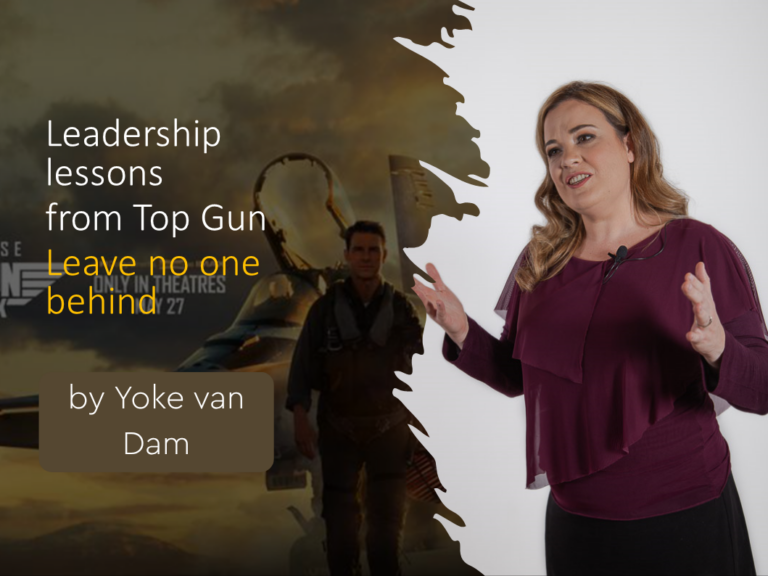

Leadership lessons from Top Gun: Maverick
Maverick is handed a room full of elite fighter pilots and told to prepare them for a mission so dangerous that command isn’t sure anyone will come back alive. He wasn’t chosen because he had a teaching qualification. He was chosen because he was one of the best. And that’s precisely where his trouble began.
The trap of being the best
Most people reach leadership because they were exceptional individual performers. The best salesperson. The sharpest analyst. The most technically skilled person in the room. That competence earns trust, credibility, and eventually a promotion. That is when something shifts. The job is no longer to do the thing brilliantly. It’s to help others do the thing at all.
This is the transition Maverick resists, and the one most leaders stumble through. The skills that got you here are not the skills that will grow your team.
The four stages every learner moves through
One of the most useful frameworks for any leader who trains or develops people is the competence ladder — a model from NLP and adult learning theory. It describes four stages:
- Unconscious incompetence — You don’t know what you don’t know. Your team members sit here more often than you think. They aren’t being lazy or resistant; they’re genuinely unaware of their own gaps. Maverick’s pilots thought they were already the best. He had to show them, diplomatically but decisively, that they weren’t.
- Conscious incompetence — Now they know they have gaps. This is uncomfortable, sometimes embarrassing, but it is the first real opening for growth. A good leader creates the conditions for this realisation without humiliating anyone.
- Conscious competence — They can do the skill, but only with effort and attention. Think of learning to drive: you’re managing mirrors, gears, observations, and road position all at once, all consciously. Exhausting. But necessary.
- Unconscious competence — The skill becomes automatic. Flow. Second nature. This is where Maverick kept pushing Rooster: stop thinking, just do. But that instruction only works once the prior stages have been completed with rigour.
The practical challenge for any leader is that most of your own expertise lives at stage four. You’ve forgotten what it felt like not to know. So the work of teaching requires you to consciously excavate what you’ve internalised and make it visible, transferable, and learnable.
Training that actually sticks
Tom Cruise didn’t just tell the cast of Maverick what it felt like to fly an F-18. He put them through three months of structured aviation training — from single-engine planes to aerobatics to launching off an aircraft carrier at full G-force. By the time they were in the jets, they weren’t performing as pilots. They could handle it.
That level of investment in capability-building is worth examining honestly. A video playing on repeat in a staff cafeteria for a year is not training. Research consistently shows that a message needs to land five to twenty times before it genuinely sinks in — and people learn through different channels. Some need visual explanation. Others need a conversation. Others need to physically try the thing and get it wrong a few times before it clicks.
If your primary training method is a document or an email, you’re probably not training anyone. You’re informing them once and hoping it sticks.
The common goal changes everything
Maverick’s most powerful early move wasn’t a drill or a debrief. It was establishing a shared objective that went beyond the mission brief: we’re figuring out if this is possible, and we’re getting everyone home. That goal reoriented every individual’s effort. It gave them something larger than personal performance to care about.
Many teams operate without a clearly articulated common goal. Not a vision statement on a wall — a real, felt understanding of what they’re collectively trying to achieve and why it matters. When Maverick named it, the pilots stopped flying for themselves and started flying for each other.
What is the common goal of your team? Have you stated it plainly? Do they believe you mean it?
Build the team, not just the skills
The beach football scene in the film drew a complaint from a superior: they have to be in the air in a week — what are you doing? Maverick’s answer was clear. You can’t build a fighting unit from individuals who don’t trust each other. The game wasn’t a distraction from the mission. It was part of it.
Gallup’s research on workplace engagement found that employees who feel they have a genuine friend at work show 60% higher retention rates. Camaraderie isn’t a soft bonus — it’s load-bearing. Teams that like each other pull harder, cover for each other under pressure, and stick around long enough to actually become good.
Core values are what hold when you’re not there
In the film’s final act, Maverick is shot down. Without him in the cockpit, his team had to make decisions on instinct, under pressure, in the dark. What they fell back on were the values and beliefs that had been shaped through training — leave no one behind, not as a slogan, but as a lived commitment. One of them turned back for him.
The question isn’t whether your team knows what your core values are. It’s whether those values are embedded deeply enough to guide behaviour when no one is watching, and you’re not available to give direction.
The sponsor no one talks about enough
Maverick would not have been in that room without Iceman. His former rival, now an admiral, had gone to the Pentagon on his behalf — not because he was asked to, but because he genuinely believed in Maverick’s value and was willing to say so to the people who mattered.
This is the distinction between a mentor and a sponsor. A mentor advises you. A sponsor advocates for you, in rooms you’re not in, to people who have the power to open or close doors.
The leadership question cuts both ways: do you have someone in your organisation who will speak for you when you’re not present? And more importantly, are you doing that for someone else?
When everything goes sideways
Downed in enemy territory with no plan, Maverick and Rooster found an aircraft that shouldn’t have worked and flew it home anyway. Creativity under pressure isn’t a personality trait reserved for the naturally inventive. It’s a capacity that either gets trained or doesn’t.
Leaders who want their teams to think on their feet have to create the conditions for it before the crisis hits. What would you do if load shedding knocked out your systems mid-delivery? What’s the plan if your key person is suddenly unavailable? These scenarios can be rehearsed. The teams that perform well under pressure are rarely the ones who are naturally cool under fire — they’re the ones who’ve already thought through the hard situations in advance.
What it comes down to
Maverick is a compelling leadership figure not because he was the greatest pilot of his generation, but because he eventually accepted that his greatest contribution wasn’t his own flying. It was making sure the people around him could fly without him.
That’s the shift. From being exceptional yourself to building conditions where others can become exceptional. From swimming in your own lane to lifting the performance of everyone in the water.
It’s harder than being the best. And it matters more.