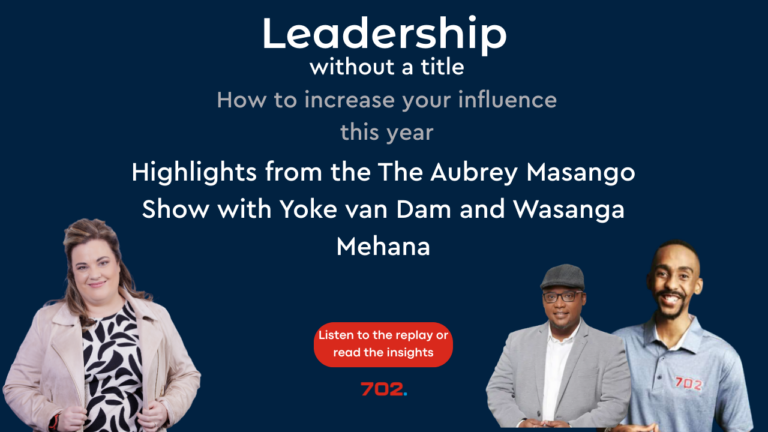

Last night, I chatted on Radio 702 with Wasanga Mehana about Becoming a leader without a title, and how to be more influential in 2026.
Listen to the replay, or see the insights below https://www.primediaplus.com/change-your-mindset-increasing-your-influence-as-someone-not-in-a-leadership-position/
1. Self-recognition:
Do Self-led high performers truly need a pat on the back? Or should you just put your head down and do the work?
· We have an internal and external frame of mind. Internal is where you can stand in front of the mirror and shout your own praises. And truly say, wow, that speech you made was amazing. You really grew in these areas. Be your own cheerleader. You know yourself best, and you can notice when you are achieving the goals you’ve set out for yourself.
If you wait for others to cheer you on, you are giving away your power. Love has to start with yourself. You need to love yourself and put on the oxygen tank for yourself before helping others. Instead of always rescuing others.
The reality is that so many of us are addicted to the dopamine rush and only feel that we are good enough when others say it to us. That’s why people are taking selfies, sharing about their holidays, waiting for the world to say to them, ” Wow, that is amazing”, versus deciding for themselves that they are having a great Last night, I chatted on Radio 702 with Wasanga Mehana about Becoming a leader without a title, and how to be more influential in 2026.
Listen to the replay, or see the insights below https://www.primediaplus.com/change-your-mindset-increasing-your-influence-as-someone-not-in-a-leadership-position/
1. Self-recognition:
Do Self-led high performers truly need a pat on the back? Or should you just put your head down and do the work?
· We have an internal and external timeframe.
Give yourself a pat on the back
An amazing tool, the Year Compass (2025-2026). When you review your past year and look at all areas of your life relating to relationships, family, hobbies & creativity, physical health, exercise, mental health, spiritual & religious, career and studies… You can remember events where you shone. You can learn from past failures and see times when you were resilient and got up when you were pushed down. And give yourself a pat on the back, audit your habits and make decisions for the next year.
Create a bragging file:
Create a folder on your computer or open a notebook, and whenever something great happens in your personal life or business life, put it in there. Like the CEO congratulating you on a project, another department saying thank you for the work you’ve done. A client who sends you a personal thank-you note. As you accumulate these, you can look at them when you are not having a great day, or when something bad happens. Our inner saboteur will always hijack our thoughts to the negative. By going back to these messages, you can show yourself that you were able to get up in the past. You are an achiever, and you will get over this.
2. Visibility and influence
How can you be influential without a title?
- Ask yourself: What is the legacy you want to leave behind? What positive ripple effect do you want to bring?
They say: fear is contagious, but so is positivity… what vibes and energy do you want to bring into every room you enter?
- Empathy: Put yourself in the shoes of the person you are influencing. What are they seeing in their world? What are they seeing, hearing, feeling and experiencing? What are their pain points and their goals? Do your homework and speak from their view of the world.
- Status: If the IT person helps you to do the project with them, will their status go up or down? Will this make them look better or worse?
- Self-awareness: Know your purpose, your values, and attract people to follow you because of the type of leader that you are.
- Energy: Understand when you have energy and focus to do the hard work. Is it in the morning, throughout the day or late afternoon? When you do, you get your vavavuum?
· Emotional intelligence: Through coaching, you can also identify your triggers and self-regulate so you can calm yourself down, or stop you from getting anxious when you haven’t eaten, are tired or being triggered.
3. Leadership and engagement (Praise, status and recognition)
If you work in a flat structure, how can you get feedback or acknowledgement?
Ask a peer or someone in a different department if they don’t mind giving you feedback after the meeting. If you get their permission first, they can pay attention and make notes to ensure that they can give you balanced feedback -where you did well, as well as areas of improvement. Where people get it wrong is when they ask someone for feedback months after doing a talk, or running a project and by then the other party has completely forgotten about it, and they weren’t critically listening to you.
If you are in a formal authority, does it give you the mandate to delegate and manage?
You may have the authority, but your people may hate you and sabotage you.
It’s important whether you are in a formal leadership position or want to lead without a title, to become the kind of leader that people want to follow.
According to the Gallup 2025 report, “Last year global employee engagement fell, costing the world economy US$438 billion in lost productivity.” And a big indicator of a lack of engagement is disengaged managers.
Should managers praise their staff?
YES. When I coach leaders, I always say reprimand in private and praise in public. When you reprimand a colleague in front of others, they lose face and status, and it has a negative knock-on effect on everyone in the room, impacting psychological safety. And yet, when you praise them in front of others, it creates a positive knock-on effect. Creating positive vibes for everyone.
If you want to be influential, you need to manage up and let your boss know about your achievements and goals. If you just put your head down and do the work, you won’t get the promotion.
4. Team transformation and tools
How important is team building?
I call it a team transformation, where you truly help the team to align, versus a ra-ra motivational session. The aim here is to change behaviour, mindsets and create new beliefs.
Use tools like the Five Lens Enneagram assessment. This can be done before the group session, where every person in the team does the Psychometric test, and they get assessed on:
- Personal mastery(how well do you accept yourself, your life and your career? Are you happy with yourself?)
- Resilience(how well you cope with stress and how you bounce back)
- Relationships (how strong are your relationships, can you count on others)
- Maslow’s Hierarchy of Needs (Are you in survival mode, or moving towards Self-actualisation)
- Global Connection(Do you feel connected to the greater world? If you are in need, do you believe that people will help you or come to your aid)
In the debrief, every individual has a 1.5 -2 hour debrief where the Coach asks them questions so they can interpret their own report, and finally, the 5 Lenses lead to your Enneagram Style.
- It’s important to notice that the Five Lenses is extremely personal, and the Enneagram style is outward behaviour that people will notice in you.
- You can operate on a highly integrated level, or on a very low integrated level, which has to in some ways have to do with your Emotional intelligence. It’s important not to label anyone, but rather learn about yourself, and this helps your team understand you better when you have a team session to see what styles everyone has. And how you can work better together.
- The tool is also a great way to get self-awareness and identify areas for growth for your coaching journey. (Reach out to me if you want to get more information on doing a Five Lens Assessment for you or your team)

How can you show appreciation to close relationships in your life?
Write them a personal note or a letter telling them how much they mean to you and thanking them for the person that they are.
5. Emotional regulation and inclusion
How do you shut down the corporate silence when there is racial tension?
The moment you are excluding: gender, race, sexual orientation, language or even religion, people feel disconnected. It’s important to, in a calm way, call that out, sorry, that is not welcome here; here are all the colours of the rainbow that are welcome. In a company, you need to very quickly reframe and call it out to include. Let’s be inclusive. How can we turn that phrase around to be inclusive to all cultures, genders and groups? If you keep quiet, you are saying that the behaviour is ok.
What are the values of our company, and how do we want people to feel? Does this conversation make people feel safe, hold people accountable for their behaviours and outline those behaviours?
…
Whether you’re a high performer, a leader, or someone trying to influence without authority, this is an invitation to stop outsourcing your confidence and start leading from the inside out.
Audit your wins. Build your self-awareness. Praise loudly, reprimand privately. Create environments where people feel safe, seen, and valued — including yourself.
If you need support, you know who to have a call with.